

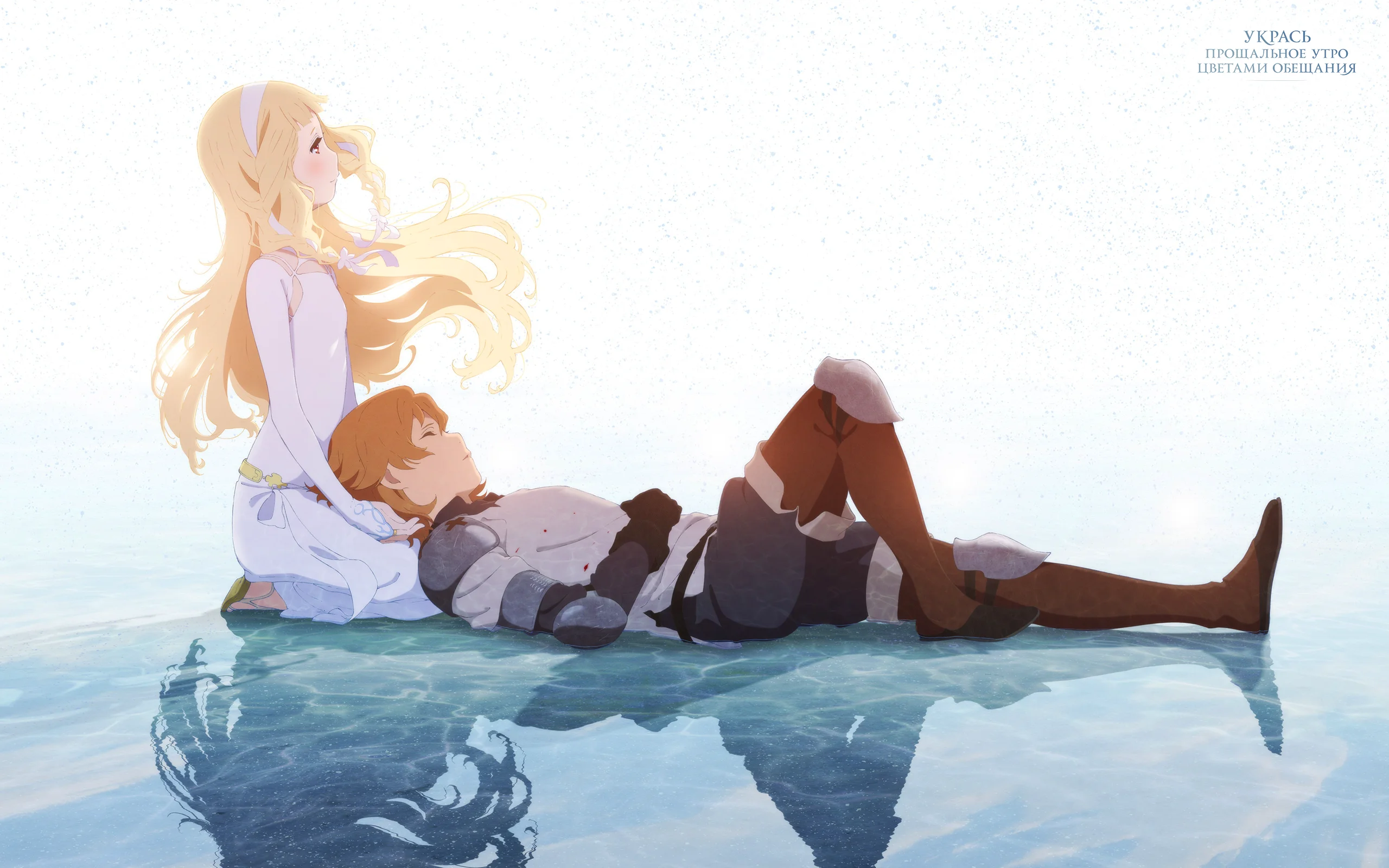
Maquia and the eternal love
My favourite anime movie is about an immortal girl raising a human child she'll outlive. It made me think about my mother, and everything she gave up so I could be here.
I don’t cry easily at movies. I don’t know if that’s something to be proud of, but it’s true. I’ll feel things (a tightening in the chest, a heaviness), but the tears don’t usually come. Maquia: When the Promised Flower Blooms broke that streak.
I’ve watched it twice now, and both times I had to sit with it for a while after. Not because it was sad in the conventional way (though it is that), but because it surfaced something I don’t usually let myself look directly at: what my mother actually gave up for me.
What the movie is
Maquia is the debut film of Mari Okada, one of the most emotionally fearless writers working in anime. The premise, on paper, sounds like fantasy: Maquia is an Iorph, a race of immortals who stop aging at fifteen. When her village is destroyed and she finds herself alone in the human world, she comes across an orphaned infant and decides to raise him as her own.
His name is Ariel. He grows up. She doesn’t.
The film spans decades: Ariel as a toddler, a teenager, a young man, a soldier, a husband, an old man on his deathbed. Throughout all of it, Maquia looks exactly the same as the day she found him. The story is not about that gap being a problem to solve. There is no fix, no loophole. The film simply lives inside that gap and asks: what does it mean to love someone you are guaranteed to outlive?
The answer it gives, quietly, over two hours, is: it means everything. And it is worth it.
The scene that got me
There’s a moment near the end: Ariel is very old and Maquia comes to see him for the last time. His face is lined, his body worn down by decades she didn’t share. She is still fifteen.
He calls her mother.
She has been afraid to claim that word for most of the film, worried that the strangeness of their situation (her immortality, her apparent youth) makes her unworthy of it. But in that final scene, the word lands the way it was always supposed to. She raised him. She was there. That’s what a mother is.
I watched that scene and thought, immediately, about my own mother. Not because there’s anything supernatural in her story, but because the film put something into focus that I usually let stay blurry.
Where I come from
We were not a wealthy family. Money was tight in a way that shaped everything: what we ate, where we went, what got bought and what didn’t. My parents knew what that meant for themselves and didn’t complain about it. There was no money spent on comfort or convenience or anything that wasn’t necessary. I didn’t fully understand any of this while it was happening, because children don’t, and that’s probably the point: they were making sure I didn’t have to understand it.
What they did do was put me in a private school.
That’s the thing I keep coming back to. They looked at what little they had, and they decided that a chunk of it (a real, substantial chunk) would go toward giving me a better shot than they’d had. Not because anyone told them to. Because they had decided, quietly and without ceremony, that my future mattered more than their present comfort.
I got the education. They got by.
What Maquia gave me
The film understands something about that kind of love that most stories don’t quite reach. Maquia never expects gratitude. She never holds her sacrifice over Ariel’s head. She just loves him, through his rebellion, his distance, his growing into a man she can barely keep up with, and asks nothing in return except that he live well.
That felt true to me in a way that was almost uncomfortable to sit with.
My mother has never once listed what she gave up. She doesn’t speak in the language of sacrifice. She just is: a constant, undemanding presence that I took completely for granted for most of my childhood, and only in adulthood have started to understand the shape of.
I think about the years when I was a teenager and too absorbed in my own world to pay much attention. I think about how little I asked about her life, her dreams, what she might have wanted for herself if the circumstances had been different. I think about the version of her that existed before she was a mother, and how little I know about that person.
Maquia made me want to ask more questions.
Why it stays with me
It’s my favourite anime film because it’s the most emotionally honest thing I’ve watched. It doesn’t dress up the difficulty of love or round its edges. It lets the grief be grief. It lets the joy be joy. And it earns its ending: two people who have lived vastly different lives, shaped by each other in ways neither fully understands, saying goodbye with everything that needed saying left finally said.
I called my mother after I watched it the first time. I didn’t tell her why. I didn’t explain what I’d just seen or what it had stirred up. We just talked. I asked about her day, listened properly, stayed on longer than I usually do.
That felt like the right response to the film. Not a review, not an analysis. Just paying attention to someone who has been paying attention to me my whole life, and trying, a little bit, to close the gap.
If you have the kind of parent who gave more than they kept for themselves, watch this film. You don’t have to be ready for it. It will find the thing in you anyway.