Diary of Our Days at the Breakwater and the summers I spent knee-deep in floodwater
A CGDCT anime about girls fishing off a pier brought back my childhood summers in the village: bamboo rods, taro-stem floaters, leech bites, and my uncle who taught me all of it.
I watched another one of those shows recently. You know the genre: cute girls doing cute things. Camping, making music, riding motorcycles, running a school club that exists mostly as an excuse to eat snacks. This time, the cute things they’re doing is fishing.
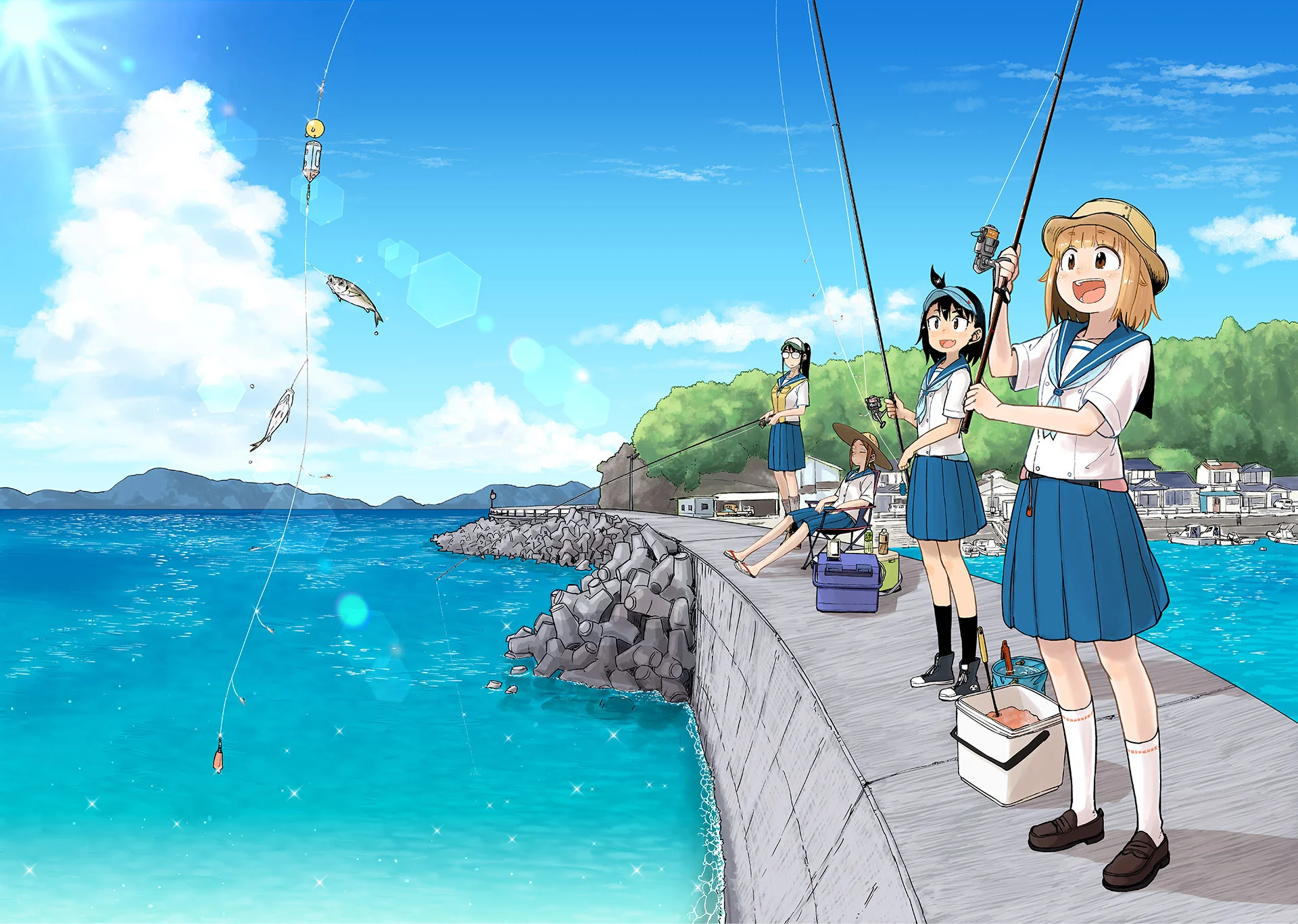
Diary of Our Days at the Breakwater is exactly what it sounds like. A handful of high school girls, a seaside town, a concrete breakwater, and fish. No stakes, no drama. Just rods, bait, the sea, and the small triumph of pulling something up out of the water.
I love a good CGDCT anime, and I especially love the iyashikei ones: the healing kind, the ones that ask nothing of you and leave you softer than they found you. This one healed something specific. It reached back about twenty years and pulled up a version of me I hadn’t thought about in a long time.
What the show is
Hina Tsurugi moves to a small seaside town. She’s an indoor person (her hobby is handicrafts, tiny delicate things made at a desk), and on her first day she gets more or less abducted into the Breakwater Club by an upperclassman who sees her holding a rod and decides her fate on the spot.
The club does one thing: they fish off the local breakwater. They learn rigs and bait and how to unhook the spiky things without getting stabbed. They catch what the season gives them, cook it, and eat it right there with an enthusiasm that borders on religious.
It’s warm, it’s funny, and the fishing is real: real techniques, real fish, real patience. Like Yuru Camp did for camping, it treats the hobby with enough respect that you come out the other side half-convinced you should take it up yourself.
In my case, there was no convincing needed. I already had.
The summers
When I was in school, summer vacation meant the village. A month, sometimes two, at my ancestral home. And summer in Assam means water. The fields flooded. The ponds, the lakes, the rivers, all swollen and spilling into each other until the whole landscape was half land, half water.
My father’s elder brother had a son my age, and every single day my uncle would take the two of us fishing. Our gear was nothing like the neat tackle boxes in the anime. We had simple bamboo rods, and for a floater we’d cut a piece of taro stem: light, buoyant, free, growing at the edge of every pond. You watched that little pale stem sitting on the brown water, and when it dipped, your heart dipped with it.
That was the civilized version. The uncivilized version was better. We’d wade into the flooded paddy fields, knee-deep, and try to catch fish with our bare hands. Mostly what we caught was leeches. You’d come out and find them fastened to your legs and do the little dance every village kid knows. It never once stopped us from going back in.
We set traps too (in the rice fields, in the small canals where the water moved), and picking them up the next morning was better than any birthday. You never knew what would be in there. And somewhere in those summers, my uncle taught me to cast a net: that full-body motion where the net leaves your hands as a mess of rope and opens into a perfect circle over the water. The first time it opened properly for me, I felt like I’d learned magic.
Man, those were days.
My uncle
My uncle passed away in early 2017. Liver problems. My cousin, the boy who waded through those fields with me, got his degree, prepared hard, and earned himself a place in the army.
I haven’t been back for a fishing trip since. Not one. The fields still flood every summer, the taro still grows at the pond’s edge, and my cousin and I have never teamed up again the way we used to. Life just quietly moved us elsewhere.
For me, elsewhere is Guwahati, the concrete jungle. You can’t fish there. There’s a mighty river running right past the city, but the life I live beside it involves traffic and deadlines, not floaters and nets. The distance between me and those summers isn’t really measured in kilometres.
Then a cartoon about schoolgirls on a breakwater came along, and suddenly I could smell the floodwater again.
On fish
Here’s a confession that would scandalize the Breakwater Club, who devour their catches with holy fervour: I’m not much of a fish eater.
I just love fish. Love being near them, love watching them. When I was young, my father used to bring home singi maas (stinging catfish), and instead of the kitchen they’d sometimes end up as pets, living with us for a long time in a simple container of water. I’d watch them for ages.
I never had an aquarium, though, and I don’t think I ever will. I don’t like caging animals. A glass box in a living room is a poor trade for a flooded field. I’d rather watch fish in their own world, and if I catch one, hold it for a moment, feel that furious aliveness in my hands, and let it go.
Because that was never really about the fish, was it? The fun is being with nature. Standing in water, reading the surface, waiting. The fish are just the excuse. The same way, I suspect, the fishing in this anime is just the excuse for four girls to sit on warm concrete by the sea and be together.
Why it stays with me
Diary of Our Days at the Breakwater didn’t teach me anything about fishing. If anything, I could teach Hina a thing or two about leeches.
What it did was remind me that I love this. That some of the happiest hours of my life were spent holding a bamboo rod, watching a piece of taro stem, next to people I loved. That the love never actually went anywhere; it’s been sitting quietly in me like a trap left in a canal, waiting for someone to come pick it up.
Maybe that’s what these healing shows are actually for. Not escape. Retrieval.
Go watch it. Preferably somewhere near water, but a memory of water will do.