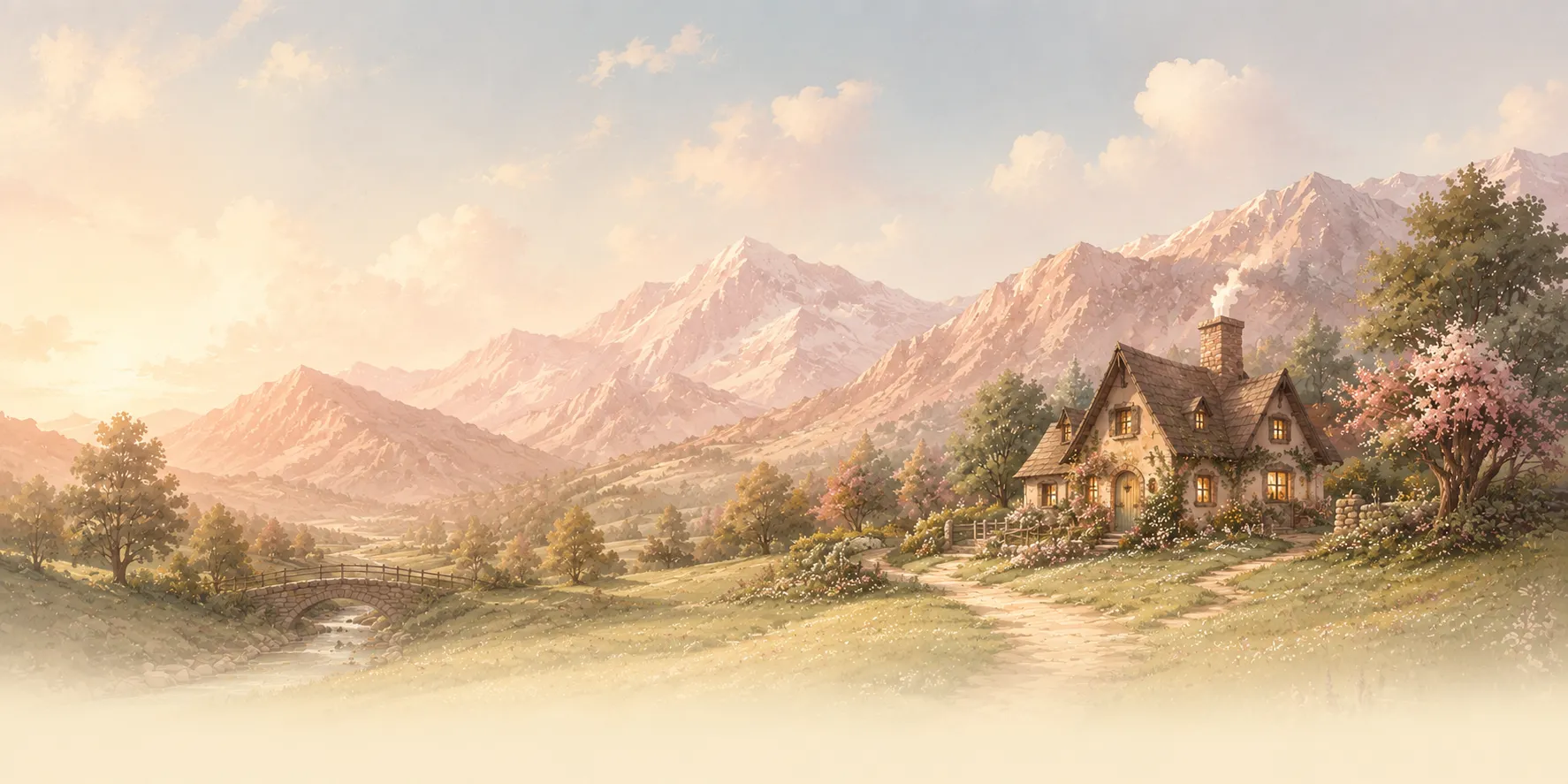

Sweetwater
On the tenth night of her employment, when the last guest was seen off (the last guest being herself, technically, a point neither of them raised), Lydia untied her apron, folded it, and stood before the counter with her hands clasped.
“Master. I would ask a liberty.”
“Sure,” said Devan, who was scrubbing the stockpot.
“The house sits closed through your resting hours. I would use those hours, with your leave, to put my own house in order.” A pause. “It has been let go.”
Two hundred years, let go. She did not say that part. He knew it anyway, or the person who had written her did, which in his understanding was the same thing.
“Take whatever time you need,” he said. “Take tools. Take food. Is the roof bad?”
“The roof,” said Lydia, with the composure of a woman describing a fallen empire, “is on the floor.”
“Take nails.”
She took nails. She took a saw, a hammer, an auger, a coil of good rope, a jar of the bottled evening, and a broom, the broom, and she carried them through her door, and went home to work.
The kitchen of the Sweetwater Inn had held a door in its wall for a month now, and Lydia had passed through it many times.
Every time before, she had come home to smoke. That was what she was, on this side: smoke and habit, a shape the wind ignored, hands that passed through brooms.
This time, her boot heel struck the floor.
She stood just inside her own kitchen and listened to the echo of it going up through the ruin: one footstep, the first in two hundred years to belong to her. Above, through the fallen roof, the sky stood pale with morning. Dew on the moss. Cold, real, against her face.
Lydia pressed her hand flat against her own doorframe, and it was wood, and it held her weight, and she stood there for a while with her head bowed, and then she rolled up her sleeves, because weeping was for indoors, and there was, at present, no indoors.
She began, of course, by sweeping.
The work took eleven days, in the hours while her master rested.
She was stronger than she had been. She had understood this at the hearth, and understood it further when she knelt to shift a fallen roof-beam (braced, out of forty years’ habit, for a weight that would take rollers and a neighbor’s ox) and lifted it off the floor the way she would lift a sleeping cat.
She stood holding the beam and revised her plans upward. The inn had nine rooms. She had thought to make three of them decent.
No. It would all be decent. It would all be right.
The young trees in the common room came out first. She was sorry about them (they had kept her a kind of company, and it was not their fault a floor is not a forest), so she took each one gently at the base, drew it whole from the broken boards, roots and all, and replanted every one along the road’s edge where the old elms had stood in her day. A row of them, small and confused and alive. In thirty years the road would have shade again.
She had plans for the road too.
The rubble she sorted with both hands, stone from timber, sound from rotten. The chimney had held (her chimney, her grandmother’s chimney, built to outlast opinion) and she cleaned two centuries of birds’ nests from it, and when she finally lit a fire in the great hearth and the smoke drew straight and true, she sat back on her heels and watched it go up, gray against the pale sky, the first smoke of the Sweetwater Inn in two hundred years.
Far down the valley, that smoke was seen. But that comes later.
The roof she raised alone. She felled spruce above the pass, squared the beams, and carried them down on one shoulder, walking with care not because of the weight but because of the turns. She pegged and jointed the frame from memory: her father’s joints; roofs on this road were done a certain way, storms here came a certain way, and the new pass had learned none of this and lost shingles every winter, not that she was keeping account. She laid the shakes in tight rows. It rained on the eighth day, and the roof held the rain out, and she stood inside in the dry, listening, for one hour, doing nothing at all.
The well took an afternoon. Two hundred years had dropped stones and silt down its throat, and a boulder off the slope had crushed the wellhead, a boulder the size of a cart, which she rolled aside absently, one-handed, the way one moves a chair. Beneath the silt the spring still ran. She drew the first bucket, and drank the first cup, and it was the same water. Cold and faintly sweet, off the high stone. The water the house was named for.
The pond came after, on the ninth day. There had been a stew-pond behind the inn in her mother’s time, for keeping the ford’s trout fresh through winter. It had silted flat two centuries ago. She dug it out again in a morning, lined it with river stone, and stocked it by hand: standing in the ford, still as a post, lifting trout out of the cold water one by one. An innkeeper keeps a live larder. Guests arrive; fish do not wait on market days.
The ducks she took the same way. Mallards wintered in the reeds below the ford, and she walked out among them, unhurried, and came back with six. The ducks, having met her, made no complaint that anyone ever heard. She built their pen against the south wall, where the sun would come in spring. Ducks had lived at the Sweetwater in her day; the duck was the house’s dish. A house should keep its dish.
That evening she did not go straight to her shift. She sat on the doorstep with a second cup of her own water, and let herself feel the size of it.
She could not keep the smile off her face at work that night. She did not entirely try.
Devan noticed, of course. He was oblivious, not blind.
His Manager had begun coming to work smelling of sawdust and woodsmoke. There were calluses rising on her hands. He was fairly sure spirits did not get calluses, but the system evidently disagreed, and the system’s attention to detail had stopped surprising him. She hummed sometimes now, at the wash basin. Old songs. The tune wandered off the note in places, exactly where a real person’s would.
Player housing, he concluded.
It was obvious once he saw it. Hire the companion, and she unlocks a settlement questline: her own building, off in her own zone, restored step by step. There was probably a whole progression tree: repair the roof, restore the well, reopen the inn, and then it would start generating something. Reputation. Traffic. Content.
“How’s the house coming?” he asked one night, casual, fishing for questline flags.
“The roof is on,” said Lydia, in the tone of a general reporting a border secured. “The well is clean. I have begun on the rooms.”
“Need anything?”
“Glass,” she said. “For the windows. Ours was poor and it is two hundred years broken.”
He made her still-glass. Fourteen panes, river water off the ninth level, frozen clear and forever. She held the first one up to the lamplight, and looked through it at the fire, unwavering, and was quiet a moment.
“This is too fine for an inn,” she said.
“It’s an inn on a mountain,” said Devan. “Winter comes. Take the glass.”
The system, he reflected, wrote her dialogue with remarkable restraint. A lesser game would have had her say thank you. This one had her fold the panes in wool, and say nothing, and stand taller for the rest of the shift. That was craft. Somebody had studied actual people.
The next week he sent hens: six brown hens from the farm terraces of his own country, in a crate he carried through the door under one arm. “For eggs,” he said. “They’re supposed to be good layers.” They were, in fact, remarkable layers. They were his world’s hens. Lydia housed them beside the ducks, asked none of the questions she had learned not to ask, and the Sweetwater had eggs.
On the eleventh day, the house was done.
Not grand. She had no wish for grand, and would have distrusted it. The Sweetwater Inn stood as it had stood in its best years: nine rooms swept and aired, beds of fresh spruce and clean wool, the long table scrubbed white, the floor tight underfoot, the great hearth laid ready. Behind the south wall the ducks muttered in their pen, the hens roosted warm, and the stew-pond held its trout under the cold sky. Fourteen impossible windows held the afternoon light and did not ripple once. On the mantel she set the only relic worth keeping whole: the old iron key to the front door, polished, hung on its old nail. The door itself she left unlocked. She always had.
The sign had survived, barely: the paint gone, the board sound. She sanded it and painted it fresh, the same as it had been, because it had been right the first time: the name, and under the name a cup with three drops falling into it.
SWEETWATER INN.
She hung it on its bracket over the road, and stepped back, and looked at it for a long time.
Then she did the last thing. She took the jar of bottled evening her master had given her, and set it in the iron lamp-cage by the front door: the traveler’s lamp, the one her mother had lit every dusk of her life, the one that said from a mile down the mountain in the dark: you are nearly there, keep walking.
It kindled to its steady gold, the light of a sunset from a world away, and the Sweetwater Inn was lit.
A lamp burning on a dead road, over a door that would not lock, kept by the strongest thing in the kingdom.
Lydia stood in the road in the falling dusk and looked at her house, and if anyone had been there to see her, they would have seen a smiling innkeeper in a clean apron, and they would have been wrong by nine hundred levels, and they would have been perfectly safe.
Before her shift, she walked her road.
Down past the young elms, past the ford singing over its stones, along the old cart-ruts her feet knew blind. Half a mile on, at the third bend, stood the boundary stone: waist-high, gray, older than the inn, marking where the innkeep’s land ended and the world’s began.
She walked to it, and one step past it.
The evening went thin. The road’s gravel stopped pressing up against her boots; the cold stopped being cold and became a fact she was remembering rather than feeling; her hands, held up against the last light, let the last light through.
Smoke and habit, one step past the stone.
She stepped back, and was flesh again, or whatever this new sturdy thing was that passed for it, and stood by the stone a while with her arms folded, looking down the long dark of the road where it ran away north toward the world: toward the towns she would never walk to, the markets, the fairs, the whole living country of it, out past the edge of her ground forever.
“Well,” she said to the stone. “This side has the inn.”
And she went home, and through the kitchen, and through the door in its wall, and tied her apron, and worked her shift, and said nothing about any of it, because a house should be seen, not described.
At two minutes past four in the morning (restaurant time, whatever that was), Devan was hanging the last pot when his vision chimed.
A new message, in the letters that were exactly the game’s letters.
[Your guest has restored a hearth in her world.]
He straightened up slowly.
[Guest-right: 9 days, 14 hours banked.]
[You may exit through any guest’s door.]
He read it three times. Then he turned and looked across his quiet restaurant at the plain wooden door in the back wall: the door that opened, as far as he knew, into the questline’s private zone, the companion’s own map, the far country the game had been keeping behind one door all this time.
Exit, it said. Him. Through there.
Fourteen years he had loved a world from inside its rails. He knew every inch of everywhere he was allowed to be, and had made a kind of peace with the word allowed, the way you do, the way he had at the office, the way consistent men do everywhere.
Devan stood alone in his restaurant with his heart going absurdly, and looked at a shut door, and grinned at it, and did not so much as touch the handle.
Tomorrow was Saturday.
end of chapter 5